

Enlightening the king: French-Swedish relations in the letters of Gustaf Philip Creutz with Gustav III
The Francophile, Finland-born aristocrat Gustaf Philip Creutz (1731–85) served as Swedish ambassador to France from 1766 to 1783. During this period, Creutz maintained an active diplomatic correspondence in French with the crown prince Gustav of Sweden (1746–92), who eventually ascended the Swedish throne as Gustav III in 1772, ended the parliamentary rule of the Swedish Age of Liberty, and restored royal absolutism.
Creutz was one of the most popular foreign diplomats in Paris during his seventeen-year tenure. This was partly due to his lavish lifestyle, which he considered crucial for effectively representing Swedish interests in the elite circles of French salon culture. His large spending, combined with a taste for gambling, frequently plunged him into debt. Nevertheless, Gustav consistently regarded Creutz as a capable, loyal, and dedicated ambassador, and in recognition of his service, awarded him the rank of Commander in the Swedish Order of the Polar Star in 1770.
Creutz’s letters to Gustav, many of which were meant to be destroyed, spanned two decades from the 1760s to the 1780s, and provide a remarkable window into Swedish-French relations in the period. Their correspondence has been partly published across three French critical editions in the 1980s by Gunnar von Proschwitz (Gustave III par ses Lettres, 1986) and two of his students, Marianne Molander (in 1987, covering the years 1766–70), and Georges Mary (also in 1987, covering the years 1779–80). Recently, the ‘Gustav’s Hand’ digitization project, led by Mikael Alm at Uppsala University and funded by the Riksbankens Jubileumsfond (2022–24) has greatly expanded access to the Gustavian collections held at the Uppsala University Library, including the Creutz correspondence. The project made Gustav’s letters available to the wider public for the first time. This was long overdue, as access to the fragile original letters has been restricted for years.
Based on the correspondence, this blog post explores Creutz’s efforts to instruct Gustav in the pre-revolutionary culture of the French Enlightenment, and why this was seen as a beneficial process for French-Swedish relations at the time.
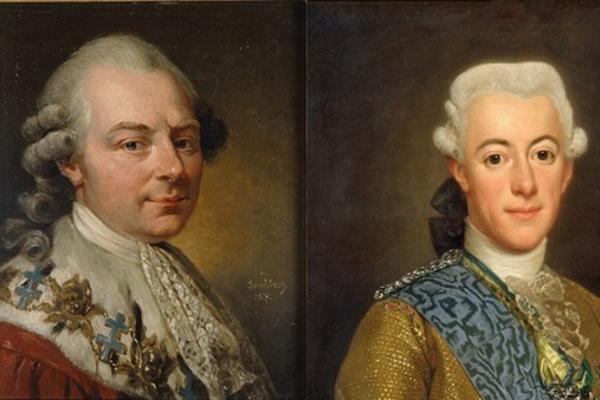
On the left: portrait of by Johan Gustaf Sandberg, National Museum, Stockholm, 1832. On the right: portrait of Gustav III of Sweden by Alexander Roslin, National Museum, Stockholm, undated.
From Supporting Party Rule to Enlightened Absolutism
Creutz’s correspondence with Gustav took place in the context of a pivotal change in 1760s French diplomacy, which shifted towards supporting the restoration of royal absolutism in Sweden. Since the 1730s, Louis XV’s diplomacy had been sending monetary subsidies to members of the Swedish Hat party in the House of Nobility (Adelsståndet), the de facto ruling chamber of the Swedish quadricameral Diet. These secret subsidies, known as the ‘French system’, were meant to ensure the continuous alignment of Swedish foreign policy with French interests.
However, following the disastrous Hat-led defeat in the Swedish-Russian War (1741–43) and the party’s loss of power to the rival Caps party, the longstanding French minister Etienne François de Choiseul concluded that French support towards the Hats had failed to deliver meaningful results. From this point on, France favoured backing the restoration of royal power in Sweden, instead of the prevailing unreliable party rule.
A key concern in the correspondence between Creutz and Gustav revolved around navigating this change of policy without alienating their allies’ finances at home. For Creutz, another corollary was the need to fashion Gustav in the eyes of Louis XV and Choiseul as a credible enlightened crown prince, a promising future despote éclairé versed in the high culture of the French Enlightenment. Such an alignment, Creutz believed, would not only help ensure a shared political and cultural vision between the two countries, but also help secure durable French backing for Gustav’s personal rule.
This proved easy to advocate, as the Francophile Gustav had already received a largely Franco-centric education. French was his preferred language and the only foreign one he knew; his mother, Queen Louisa Ulrika, was a longtime admirer of French philosophy, and two of Gustav’s tutors, the aristocrats Carl Gustaf Tessin and Carl Fredrik Scheffer, had formerly represented Sweden at the French court. Creutz’s epistolary lessons in French enlightenment culture thus often extended beyond the realm of politics. Creutz kept Gustav updated about the latest developments in French literature, music, theatre, and fashion, sparing no expense to ensure that the crown prince remained au fait and provisioned with the latest trends à la mode. Creutz also proved remarkably diligent in sending Gustav the latest publications from the philosophes, often before they were officially available. On top of volumes from the Encyclopédie, Gustav received for instance a copy in Sweden of Marmontel’s controversial novel Bélisaire in February 1767, a month before Voltaire.
Gustav was an avid, although not uncritical, reader of the literature sent to him by Creutz. Both men had a particular fondness for the works of Voltaire, whom Creutz knew personally and described as ‘the invincible champion of philosophy’. Voltaire himself had long been fascinated by Sweden, as shown by his popular biography of the late Swedish king Charles XII (1731). Gustav, who also shared his mother’s admiration for the French philosopher, confessed to Creutz that he had learned by heart all of Voltaire’s La Henriade (1723), a poem extoling the tolerance and deeds of king Henry IV of France. Upon learning this, Creutz claimed that the elderly Voltaire had ‘shed tears of joy’ and declared that ‘le Nord produit toujours des héros et de grands hommes’. Creutz sent several of Voltaire’s works to further Gustav’s education, including extracts from the philosopher’s correspondence with the king of Poland Stanislas August Poniatowski and Marie-Thérèse Geoffrin.
The French philosophical education of a Swedish monarch had a strong precedent in Descartes’ tutoring of the late Queen Christina. Creutz regarded Gustav’s Francophilia as a continuation of this legacy and praised him, along with the French Académie royale des sciences, for his pledge in 1768 to build a memorial to Descartes in Stockholm. The memorial was completed two years later by Johan Tobias Sergel, and can still be seen in the Adolf Fredrik Church.
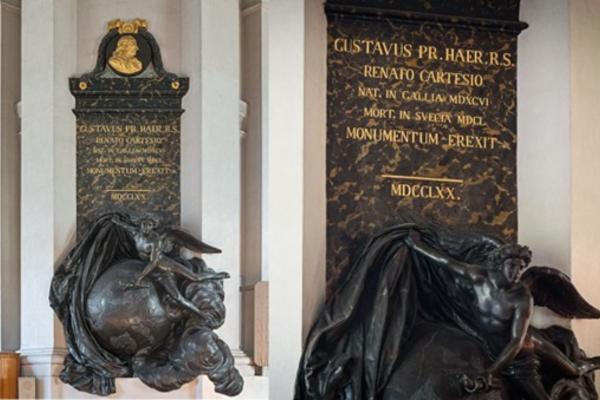
Memorial in honour of Descartes, depicting an allegory of Genius as an angel, removing the veil of Ignorance from the Earth, and bringing enlightenment to Sweden and the world with a blazing torch. A memorial plaque reads ‘Gustavus PR. HAER. R.S. Renato Cartesio, Nat. in Gallia MDXCVI Mort. in Svecia MDCL Monumentum Erexit MDCCLXX’. Adolf Fredrik Church, Stockholm.
Gustav's Visit to Paris, and his Return to Sweden as King
As Louis XV’s diplomacy began to stop funding the French system, Creutz sought to arrange a visit to France by Gustav, in the hope of persuading Choiseul and the French King that upholding the subsidies would be essential to fostering the rise of the royalist cause in Sweden. At the same time, Creutz kept Gustav informed about a recent visit by the Danish king Christian VII to Paris and Versailles in 1768–69, assuring him that his own stay in France would soon overshadow that of his Danish rival.
However, Gustav’s visit was marred by two unexpected events. First, by the time the Swedish crown prince arrived in Paris on 4 February 1771, Choiseul had fallen into disgrace and had been forced to retire. This was a major blow to Creutz’s long standing diplomatic efforts, and it also came as a shock to Gustav and the Swedish court. Once in Paris, Gustav, with the support of Creutz and Scheffer, eventually managed to convince Louis XV to resume the payment of French diplomatic subsidies.
This reversal was likely facilitated by a second development: just eight days after Gustav’s arrival, his father, King Adolf Fredrik, died on 12 February 1771. Gustav’s new status as King of Sweden, coupled with his effective networking, strengthened his position in the negotiations. Regretfully forced to cut short his visit in France to a two-month stay, Gustav swiftly returned to Sweden. With renewed support from Louis XV and Choiseul’s successor, the Duke of Aiguillon, Gustav led a largely bloodless coup eighteen months later, on 19 August 1772, which restored strong monarchical rule in Sweden. Gustav presented the regime change as a rightful reaction against endemic parliamentary corruption and a collapsing State. In planning the coup, Gustav had benefitted from Creutz’s contacts among French financiers such as Nicolas Beaujon, who provided the new king with financial backing for his operation.
While the Gustavian revolution of 1772 ushered in a new era of Francophilia in Swedish politics and society, the letters of Creutz show another side of Gustav’s early exposure to French Enlightenment culture, encouraged by a diplomacy which treated cultural alignment as a vehicle for political change in Sweden.
Vincent Roy-Di Piazza, University of Jyväskylä, Finland

