

Manuscripts and Printed Books in Fifteenth-Century Oxford
In 1535, Richard Layton, sent by Henry VIII to Oxford University, wrote to Thomas Cromwell of his success in removing old-fashioned theology books of Duns Scotus from the library at New College. In his letter he wrote, ‘we fownde all the gret quadrant Court full of the leiffs of Dunce, the wynde blowing them into evere corner’. New College’s Front Quad was littered with disbound books, their leaves scattered by the wind.
Layton’s image is evocative but, perhaps because of this, its accuracy is doubtful: Layton had reason to recommend himself to Cromwell and likely exaggerated the success of his visitations as a result. His implication, however, is worth highlighting: that the remaining fragments of disbound books can be read as evidence of those books being thrown away.
Within the wider discipline of the history of the book (Layton’s comment notwithstanding), fragment studies is a relative latecomer. Most manuscript fragments have tended to be ignored by historians in favour of ‘complete’ codices, but this post will demonstrate how analysing fragments themselves can speak to broader truths about the book culture of late medieval Oxford upon the arrival of print.
Rather than being left to drift in the wind around the quads of Oxford colleges, it was common for fragments, usually one or two leaves from a broken manuscript, to appear as flyleaves and pastedowns (leaves stuck to the inside of a book’s cover) in later bindings of books. These protected the pages of the main textblock from the heavy wooden boards that form the cover. Considered in large numbers, these binding fragments can reveal trends relating to which particular manuscripts were being thrown away.
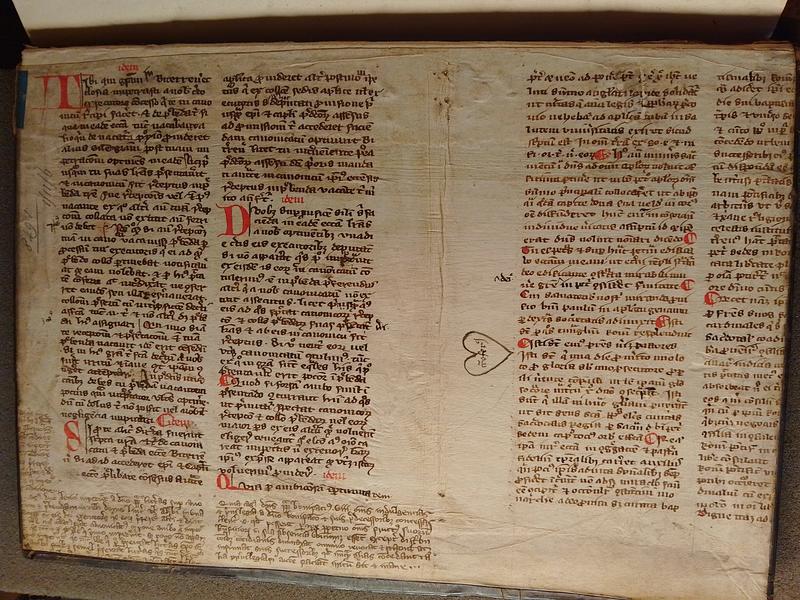
Oxford: Bodleian Library, Auct. 2 Q 4.48, a late thirteenth- or fourteenth-century manuscript fragment of the canon law text, Liber Sextus of Bonifacius VIII, used as the front pastedown in a late fifteenth-century Oxford binding.
Twentieth-century palaeographer Neil Ker did this to great effect in his book, Pastedowns in Oxford Bindings, a catalogue of the manuscript fragments used in Oxford bookbinding from the late fifteenth to the seventeenth century. Ker showed that, in the Oxford bindings that survive from around 1480 until 1530, fragments of thirteenth- and fourteenth-century legal manuscripts are most common. He demonstrated that binding fragments in Oxford books from the late fifteenth and early sixteenth centuries can provide evidence of what books were being discarded in Oxford, and suggested the prevalence of legal fragments was due to college libraries replacing their old, outdated legal manuscript textbooks with newly available printed copies of the latest edition of a text.
As many have demonstrated, the impact of the development of the printing press in the middle of the fifteenth century on the medieval book trade in Europe is undeniable, even in England, which had only a handful of printers and was initially almost entirely reliant on books imported from continental Europe. Yet a closer analysis of Oxford college libraries suggests that the impact of the printing press on their collections was not so revolutionary. It seems unlikely that the main source of fragments were libraries throwing out their books.
The main problem created by the acquisition of printed books for libraries was one of space on shelves. If a library had space for both a manuscript and a printed copy of the same text, there was no urgent need to throw one away. For colleges with large library rooms, or recently renovated libraries (such as Oriel, whose new library room was finished in the middle of the fifteenth century), it is unlikely that there would be a need to get rid of their manuscripts.
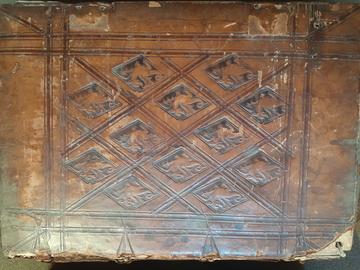
Oxford: Bodleian Library, Auct. 2 Q 3.15, a typical early sixteenth-century Oxford stamped binding
Similarly, Balliol’s new library was extended in the late fifteenth century to accommodate the substantial manuscript donation by William Gray in 1478; there can have been no need or desire to throw away such newly acquired books. Lincoln, with its donation from its founder Richard Fleming, and his nephew Robert, over the course of the fifteenth century was in a comparable position. The college must have been reluctant to throw away manuscripts which were so recently donated.
For some college libraries, Queen’s, Exeter, St Edmund Hall, and University College, there is very little surviving documentary evidence. This is suggestive of low levels of library activity, a slow rate of change of collections, and manuscripts not being replaced with printed books.
To this group of colleges with little evidence of printed book acquisition, we can add Merton, whose printed collection appeared in donations only at the very end of the fifteenth century, and there is no evidence of the purchase of print until after 1535. There also seems to have been a recognised reluctance for printed book acquisition. When the warden John Trowell resigned in 1491, he gave his manuscripts to Merton, and his printed books to Syon College, where, presumably, they would have been better received.
There is evidence of printed books arriving in the libraries of Magdalen, All Souls, and New College, but the remaining manuscript collections at these colleges are so substantial that they do not indicate a wholesale removal to make way for print. Indeed, there is evidence for ongoing acquisition of manuscripts in the sixteenth century, when, for instance, William Warham gave twenty-five manuscripts to New College in 1508. And the founding collections at Brasenose and Corpus Christi (the early sixteenth-century foundations), consisted mainly of printed books, and only a few manuscripts, unlikely to be discarded so early in the libraries’ histories.
The arrival of printed books in Oxford may not, therefore, have made a significant and immediate difference at an institutional level. Its impact was more significant for individual Oxford scholars. The printing press enabled the acquisition of the latest edition of a text, in a form that was lighter, easier to transport, and cheaper to buy than the manuscript equivalent. With the arrival of print, books could be acquired by more people and in greater numbers. Could it be that this made the movement of books between personal collections simply more fluid, more dynamic? Could it be possible that in the faster-paced exchanges of new, printed books, manuscripts in personal collections became devalued and vulnerable to loss and fragmentation? And might it be the case that, with personal collections increasing and thus college libraries declining in significance, a college library might be reluctant to fill shelves with donated manuscripts of texts they already owned?
At the end of the fifteenth century then, there is no strong evidence in library documentation of a swift collegiate replacement of manuscripts with printed books, resulting in the discarding and fragmentation of college manuscripts. Ker’s suggestion that the surviving binding fragments are the result of the great and immediate change wrought on college libraries by the arrival of print is too simplistic. Although the fragments consistently show a pattern of discarding thirteenth- and fourteenth-century legal manuscripts, such manuscripts may have come from other book repositories than college libraries, the private collections of Oxford scholars, and the losses of books moving between individuals, and between individuals and college libraries. Further, fragments have added nuance to the history of Oxford book collections, in a way that a consideration of only the surviving bound books could not.
Jemima Bennett is a doctoral student at the University of Kent and Bodleian Libraries. Her research investigates manuscript fragments used as endleaves in pre-Reformation English bookbinding.

