Thomas Barlow’s Europe: Universities and Early Enlightenment Culture
The only seventeenth-century 'Thomas' to have enjoyed conference-level attention has long been Thomas Hobbes — until 'Thomas Barlow's Europe: Universities and Early Enlightenment Culture' took place on 23–24 April 2026 at All Souls College and The Queen's College, Oxford. Barlow's transformation from one of the least interesting figures in seventeenth-century history into a conference-worthy subject is remarkable in itself, and there was much to reflect upon over these two days. Taking Barlow as its point of departure, the eleven papers and one keynote address delivered across the two days shed new light on the rich and strikingly underexplored dimensions of seventeenth-century intellectual, political, religious, and literary culture, setting a new agenda for future research.
The first panel, 'Reading Barlow's Enemies', examined the literary and political contexts in which Barlow operated. Noah Millstone situated Barlow's considerable collection of Roman Catholic indices of prohibited books within the broader Protestant culture of collecting such indices. Attending to the enemies' work could, however, be controversial: Ben Card showed how Barlow's chaplains worried that their late master's inclusive reading list might appear dangerously heterodox. Meanwhile, Mark Goldie and Jon Parkin revealed how closely Barlow was linked to English politics in the 1670s, when he was asked to write a response to Thomas Hobbes's manuscript treatise on heresy.
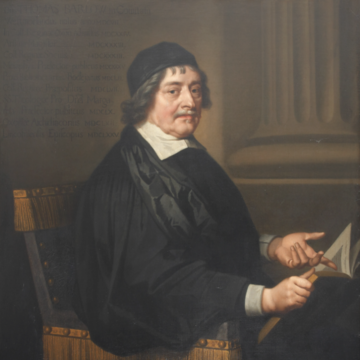
A portrait of Thomas Barlow c. 1672
The keynote speech by Anthony Milton, 'Thomas Barlow and Publication', examined the varying modes and methods of Barlow's writings, encompassing a wide range of his manuscripts, annotated books, and printed materials. Milton's keynote chiefly addressed the tantalising question of why Barlow published so sparingly when he wrote so much, while also drawing attention to the broader late-seventeenth-century literary landscape in which manuscripts were still produced and circulated for their distinctive merits.
Panel 2, 'Enlightening/Enlightened Oxford', explored the institutional contexts of Barlow's ideas and his literary strategies. Jacob Chatterjee charted the rise of anti-Calvinist theology at The Queen's College among the younger generation, despite the outspoken Reformed position of Barlow as provost. Hannah Dongsun Lee, by contrast, illustrated how Barlow himself was a sympathetic reader of Continental anti-Calvinist and Catholic authors, at least with respect to ideas of law and obligation. J. D. Eynard classified Barlow's notably frequent use of 'if' into three types and examined its institutional, casuistical, and political effects.
The final panel, 'Episcopal and Reformed', offered a substantial reconsideration of the two labels most commonly attached to Barlow. Kenneth Fincham and Stephen Taylor highlighted the diversity of mid-seventeenth-century episcopalianism within Oxford alone, pointing to the curious absence of Robert Skinner, Bishop of Oxford, from previous historical accounts. Tracing a lineage of 'Reformed Hebraism' running through John Selden, Edward Pococke, and John Lightfoot, Abby Hayton argued that Barlow's Hebraic learning represented a Reformed mainstream rather than an aberration from figures such as John Owen. In a similar vein, Jake Griesel demonstrated the central place of scholastic method in the thought of the leading Reformed theologians Barlow and John Pearson, challenging the assumption that the method had grown obsolete and been superseded by the late seventeenth century.
On the second day, we were fortunate to hear from The Queen's College librarian Matt Shaw and assistant archivist Amy Ebrey, who also hosted an exhibition of Barlow's books and manuscripts. Ebrey elucidated Barlow's role as provost, discussing his working practices and contributions in comparison with those of other provosts. In the course of outlining his administrative activities, she presented several types of archival material, including the college register, indenture, and benefactors' book. Shaw guided us through the making of the 'modern' library and its European context, as well as through Barlow's voluminous collection of books and manuscripts. The practicalities of the early modern book trade and Barlow's pencil annotations were also highlighted, giving vivid life to his bookish legacy.
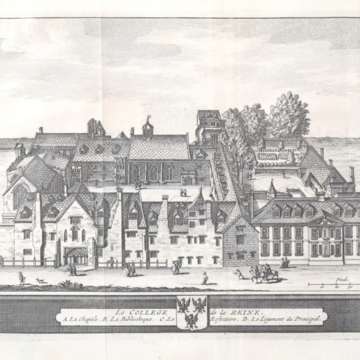
The Queen's College, c. 1727
Two recurring themes emerged across the two days. The first was the relationship between Barlow's authorship and his various social roles. He was a college provost, a professor of divinity at Oxford, a librarian, a bishop, and a vehement anti-Catholic campaigner. Despite these multiple distinguished titles and his high contemporary reputation, he rarely set out to write — still less to publish — a definitive treatise. As Milton's keynote observed, a considerable portion of Barlow's writings took the form of 'letter-tracts' and what Barlow himself called 'analecta' or 'animadversions'. Where we might expect an authoritative and even dogmatic voice from someone of Barlow's standing, he kept many of his writings flexible and open to revision. It may have been partly this indeterminacy that led some of his sympathisers, as Card's paper showed, to worry that his writings might be gravely misunderstood. How did he position himself as an author, and who was his intended audience? More broadly, how should we approach these 'letter-tracts' in an early modern context? Are they necessarily 'lesser' or 'incomplete' when set beside printed treatises? Given the wealth of such materials left by Barlow, a study of his output would have much to contribute to recent scholarship on knowledge production and reading practices.
The second theme was the question of Barlow's distinctiveness within his institutional and intellectual circles. Although the notion of his general intellectual backwardness has been rendered untenable by the contributions of Hayton, Griesel, and Lee, his militant Calvinism and anti-Catholicism did set him apart from the succeeding generations at his college and in the Restoration Church, as Milton and Chatterjee discussed. How are we to understand these long-term changes? The combination of Barlow's ecumenical sociability and his firm defence of his own theological and ecclesiological positions also surfaced repeatedly throughout the conference. Was he a trimmer, as Card and earlier accounts suggest? Or is there scope for a new portrayal of him as a sociable, well-connected, and intellectually consistent figure? Reconsidering Barlow's position promises fruitful enquiry into the intellectual culture of early Enlightenment England.
We would like to thank the Centre for Intellectual History, the Faculty of History, the Voltaire Foundation, the Centre for Early Modern Studies, and the New College Ludwig Fund for generously supporting this event. For all his many faces, he wouldn't have been too opposed to the idea of reflecting on his intellectual legacy in Oxford.
Jacob Chatterjee is Weston Junior Research Fellow at New College, Oxford
Ben Card is PhD candidate at Yale University
Hannah Dongsun Lee is Associate Professor at Tokyo Metropolitan University

