

Rethinking Humanism: Classical Persia and Elizabethan England
In the 1570s, the Elizabethan court watched as the story of a prince without equal was performed on stage before them. This prince was defined by superlatives: a conquering warrior; generous, just, and perceptive; so alluringly charismatic that an enemy might fall at the ruler’s feet in obedience to him. This figure was Cyrus the Great (c.590 - c.529 BCE), the legendary founder of the Achaemenid Persian empire. The Persian monarch's appearance on the court stage - as the eponymous hero of The Warres of Cyrus - was subsequently translated to the page, with the drama's print publication in 1594. Behind these dramatic appearances lies a wider story, of the reception of Persia in early modern England. The influence of classical Greek and Roman frameworks on the intellectual culture of early modern Europe is axiomatic - a defining feature of Renaissance political thought. That of classical Persia, however, is often overlooked. Yet for early modern audiences, Cyrus's classical Persia stood alongside Greece and Rome as a fixture of the intellectual landscape.
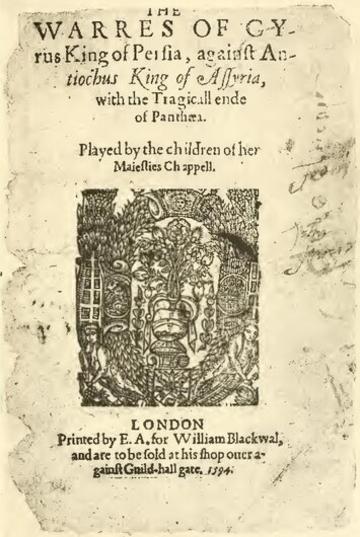
The Warres of Cyrus King of Persia, against Antiochus King of Assyria with the tragicall ende of Panthæa. Played by the children of her Maiesties Chappell (London, 1594)
Much of Persia's allure can be traced to the Cyropaedia - or 'Education of Cyrus': the fictionalised biography written by the Greek historian and philosopher Xenophon (c.430 BCE - c.350 BCE). Narrating Cyrus's upbringing, construction of, and rule over an unmatched empire up to his death, Xenophon provided the image of the incomparable prince. Men, Xenophon's preface explained, seemed almost fundamentally ungovernable. Lasting political stability appeared close to impossible. That was, until one remembered Cyrus - not only so awe-inspiring that few dared to challenge his rule, but so magnetic that whilst other kings struggled to maintain their authority, subjects far and wide voluntarily sought submission to the Persian monarch. Cyrus surpassed all others, Xenophon claimed, in 'princely dominion'.
Xenophon's text ensured that Cyrus and Persia would remain closely linked to Greece and Rome in early modern minds. Classical scholars have highlighted the close relationships between Greek polities and their Achaemenid Persian neighbours. Xenophon embodied these relationships. The author of the most famous account of a Persian king was well-known as a student of Socrates and a contemporary of Plato. Yet this Athenian philosopher was also a general in Persian service, famously leading 10,000 Greek mercenaries in support of another Cyrus - the Younger - as he attempted to replace his brother on the throne. In Rome too, Xenophon's Cyrus shone brightly as an exemplar of rule. The orator and statesman Cicero - a paradigmatic figure for early modern classical scholars, around whose notions of humanitas Renaissance humanism was defined - claimed to have modelled elements of his own political career upon Cyrus. Xenophon's Cyrus was to Cicero 'the portrait of a just ruler'.
As European political thought increasingly turned to classical texts in the fifteenth and sixteenth centuries, the Cyropaedia featured prominently. The mirrors-for-princes tradition was a particularly influential genre of political advice literature, which drew frequently upon Xenophon's text. In Niccolò Machiavelli's The Prince (1513) - one of the most influential, and shocking - pieces of Renaissance political thought, the Cyropaedia was the only text, other than his own, which Machiavelli recommended to his readers.
This intellectual genealogy ensured that, as the study of Greek and Latin texts began to be popularised amongst elite circles in sixteenth-century England, Cyrus and Persia were familiar features. The young King Edward VI owned at least two copies. By the start of Elizabeth's reign, knowledge of Cyrus could be expected of an educated audience. In 1561, translator and ambassador Thomas Hoby published an English edition of Baldassare Castiglione's The Courtier - a seminal literary portrait of the ideal court gentleman. Available in Italian, Spanish, and French, this work influenced court culture across Europe. Hoby defined it by comparison with Cyrus. There was 'no more imperfection in this Courtier' than in Xenophon's Cyrus, the ideal gentleman 'as necessarie and proper' a model for a courtier, as Cyrus was for a king.
Hoby highlighted Persia's distinctive allure as a political model for Elizabethan England. Unlike many of the Greek and Roman polities upon which scholars have usually focused, Cyrus provided a model of effective monarchical government. Classical learning was prized as a source of direct contemporary political insights. Yet Greek frameworks - Athenian democracy or Spartan militarism, for example - frequently lacked clear parallels with Tudor monarchy. Rome offered a republic, and a range of emperors who could appear as exemplars of skilful princely rule, or just as easily as usurpers, destructive of republican liberty. In an age where classical parallels were used to inform political practice, equating the Queen with an unflattering Roman emperor might be subversive. Xenophon's Persia, by contrast, offered a vision of a peerless prince, a glamorous court, and a warrior nobility: a powerful model for those looking to reinforce Elizabeth's monarchical authority.
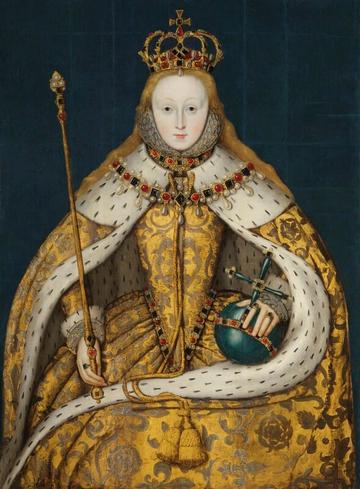
The coronotion potrait of Elizabeth I. Elizabeth is accoutred with orb, sceptre, and imperial crown; symbols of personal authority.
In 1567, the first complete English translation of the Cyropaedia was published, the first six of Xenophon's eight books having appeared around 1552. The political vision they contained - of a polity ruled not through representative structures, or reliance on counsellors, but through a monarch's awe-inspiring personal authority - influenced Elizabethan politics. Perhaps the period's most pressing political debate surrounded Mary, Queen of Scots, Elizabeth's cousin, imprisoned in England. A Catholic monarch in Protestant England, Mary was at the centre of several plots to depose Elizabeth. The question was whether to execute Mary for treason. MPs, and voices within Elizabeth's Privy Council, argued that the security of Protestant England depended upon it. On the other side of the debate was the issue of monarchical legitimacy: if Elizabeth executed a monarch, might her own authority as a divinely appointed ruler be weakened?
The Warres of Cyrus intervened unequivocally. Its dramatization of the Cyropaedia aimed not simply to entertain, but, through an analogy between Elizabeth and Cyrus, proffered an ideal of politics. Its Cyrus, himself a dazzling embodiment of princely authority, intervenes on-stage to protect a captive queen, explicitly spelling out that only God can determine a monarch's fate. By spurning the arguments of these MPs and Councillors, the drama suggested, Elizabeth could embrace Cyrus's model of successful, authoritative rule.
This drama offers only a glimpse of Persia's place in Elizabethan culture, but it is a telling one. In one of the reign's most spectacular political dilemmas, classical Persia was mobilised as a guide to action. It is revealing that historians have long identified republican Rome as the political lodestar for many of those who took the opposite side in these same debates, urging Mary's execution. Persia stood alongside Rome in the humanist intellectual landscape. But it also provided an alternative to it. As Rome underpinned republican ideals for those seeking to act independently of, even direct, their monarch, Persia guided those who looked to princely authority to secure the state.
Ebrahim Joseph is a DPhil candidate in History at Magdalen College, Oxford. His article, 'Honour and Deceit in The Warres of Cyrus, Classical Persia, and Elizabethan Politics', is out now with Historical Journal

